What is AI governance?
Now that we have asked ourselves the right questions about how to integrate AI into the business, identified the different uses and established the basic best practices, another step becomes essential: knowing how to govern it.
This is where governance comes in. Its purpose is not to restrict use, but to enable everyone to know how far they can go, under what conditions and with what guidelines.
What do we mean by “AI governance”?
AI governance refers to the rules, responsibilities and measures put in place to regulate its use within an organisation.
It clearly defines what can be done, under what conditions, using which tools and data, and with what level of supervision.
Why is it important?
Using AI involves many day-to-day decisions: What information can we give it? Can we use what it produces directly? What should we do if we are in doubt? Without a common answer to these questions, everyone might come up with their own answers.
Governance helps harmonise usage: it gives teams clear guidelines, clarifies responsibilities and enables the business to benefit from the opportunities offered by AI while retaining control over how it is used.
The next step is to turn this general framework into rules that can actually be applied in the business.
Where to start?
Before setting rules, the best is to:
-
Map existing uses and the tools involved.
-
Identify the people who set the rules, those who apply them and those who need training.
-
Set the priority rules, starting with the areas that carry the greatest risks.
-
Provide training, communicate and then review the rules regularly, as usage evolves quickly.
Once these foundations are in place, it becomes easier to identify where rules need to be defined.
In particular, regarding:
-
Data and sovereignty. This means defining which data can be used, which must remain confidential and when it should be anonymised. The choice of AI (hosted in-house, in Europe or elsewhere) also depends on how sensitive the data is. The GDPR is an essential point of reference.
-
Tools and security. List the authorised tools and the conditions for using them, then set rules for connecting AI to an internal system.
-
Content and transparency. Specify how to handle protected content and AI-generated creations, when to indicate that content was produced with AI assistance, and which high-impact uses need to be documented. European businesses also need to be aware of the obligations set out in the AI Act.
-
Retention and resource efficiency. Determine which prompts, results or histories can be retained, and for how long. It is also worth considering whether AI is the most suitable solution, or whether an alternative that uses fewer resources would suffice.
This is only a non-exhaustive list of points to bear in mind. Rules should be defined according to the uses, needs and specific circumstances of each business.
What role should human involvement play in AI governance?
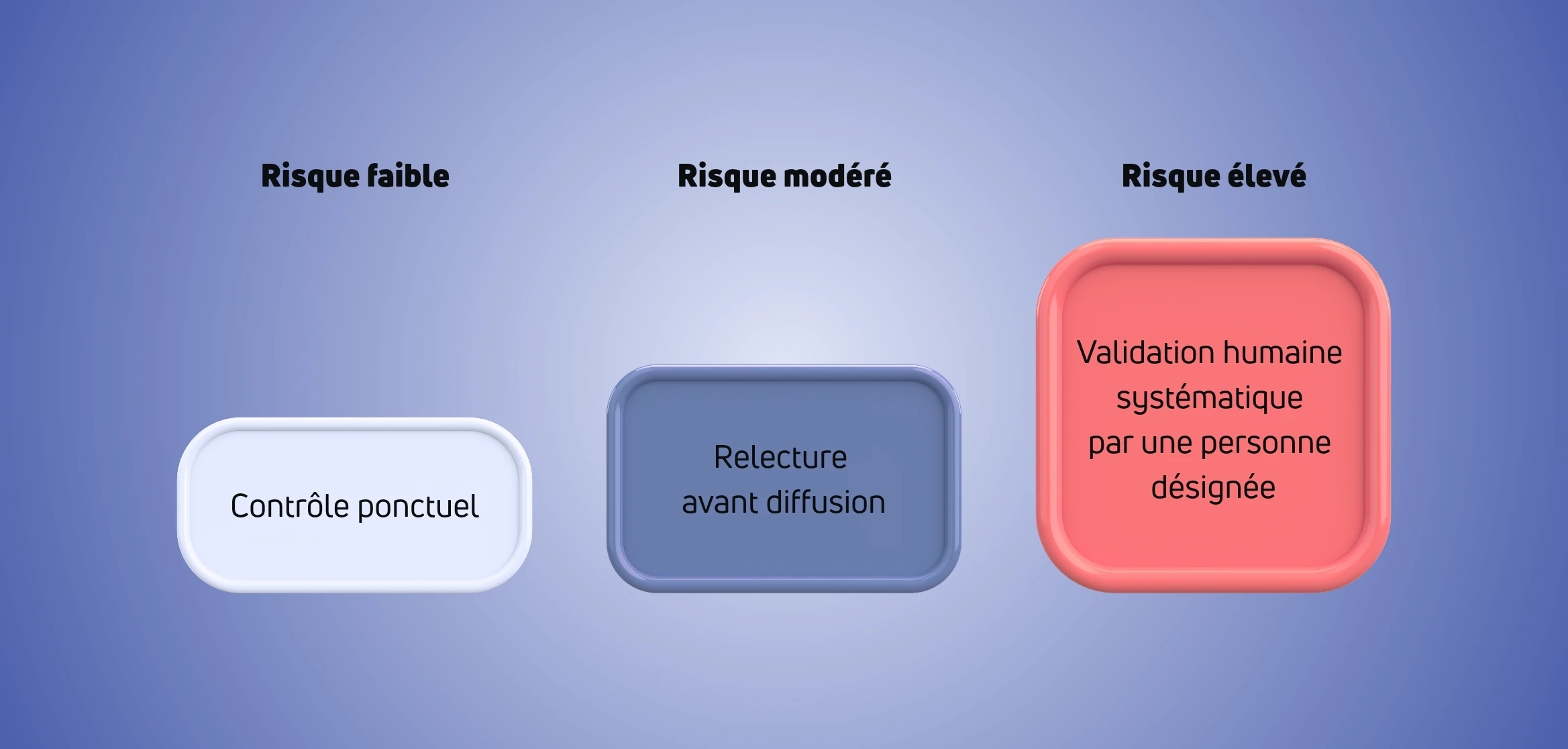
Even with all the rules in place to regulate the use of AI as effectively as possible, human supervision remains essential, although it does not need to be systematic.
It should be proportionate to the risk: content intended for an external audience, a decision affecting an individual, sensitive data or an error with serious consequences all warrant more thorough checks.
In practice, this supervision can take the form of proofreading, fact-checking or approval before action is taken. Governance therefore specifies not only when approval is required, but also who is qualified to give it: the person with relevant expertise who has been identified as responsible.
What if there is an error or incident?
Mistakes can happen quickly: sending something to the wrong recipient, using unverified information or using a tool outside its intended scope.
The important thing is to anticipate these situations as much as possible and know how to respond when they arise.
Governance defines who to notify, how to report the incident, what corrective action to take, and how to learn from it to prevent it from happening again.
Translating the rules into a charter or practical guide
Not to be confused with governance, a charter or practical guide translates the rules defined by the company into simple instructions that are easy to follow in everyday work.
It can specify which tools are authorised, what types of data can or cannot be used, which situations require human approval, good practices to follow, and who to contact if in doubt.
The aim is to help teams quickly find the essential information without having to search through several documents or interpret the rules themselves.
To be genuinely useful, this resource must be clear, accessible, practical, suited to the company’s actual uses and, above all, regularly updated.
Keep it up to date
The ways AI is used can change quickly: a tool used today for a specific task may meet other needs tomorrow or become integrated into new processes.
Governance must therefore be reviewed regularly to ensure it remains suited to the company’s reality, new uses and changes to the tools.
Need help?
Putting AI governance in place may seem complex at first. However, by starting with the company’s actual uses and taking things step by step, it is possible to build a clear, appropriate framework.
Dexio can support you through this process, from identifying uses to putting the rules into practice.
Our team can help you to:
- map existing uses
-
define a framework
-
help draft a charter
-
support your teams
-
integrate rules or approval steps directly into tools
-
review governance over time
Would you like to put AI governance in place or develop your existing framework? Let’s talk.