Vibecoding: saving time now, or building for the long term?
Create an application in a few minutes from a simple description?
That is the promise of vibecoding.
And today, that promise is no longer theoretical.
An interface, a feature, a prototype, sometimes even a first complete version: AI tools now allow code to be produced at an impressive speed.
At Dexio, we use them every day.
- To explore faster.
- To document more effectively.
- To test more.
- To generate some codebases.
- To speed up repetitive tasks.
- And to challenge our technical choices.
But there is a fundamental difference between making code appear and building a business tool that lasts over time.
Because the real cost of software is not only determined at the moment it is developed.
It reveals itself afterwards.
- When it needs maintaining.
- To evolve it.
- To fix bugs.
- To secure the data.
- To add new business rules.
- To integrate it with other tools.
- To hand it over to another team.
- Or simply to understand why a feature does not behave as expected.
Because with vibecoding, the real question is not whether AI can code quickly, but whether what it produces can become a reliable, maintainable and durable tool.
What exactly is vibecoding?
Vibecoding consists of describing what you want in natural language, then letting AI generate a large part of the code.
In some contexts, this is extremely useful.
To test an idea, create a mock-up, explore an interface, automate a small task or quickly produce a prototype, the gains can be significant.
But as soon as we are talking about a business application on which your business relies daily, connected to real data and intended to evolve over time, the requirements change.
A business tool must not only work in a demo.
It must remain reliable over time.
The real cost of speed
This is the point often forgotten in the excitement around vibecoding.
Yes, AI can accelerate code writing.
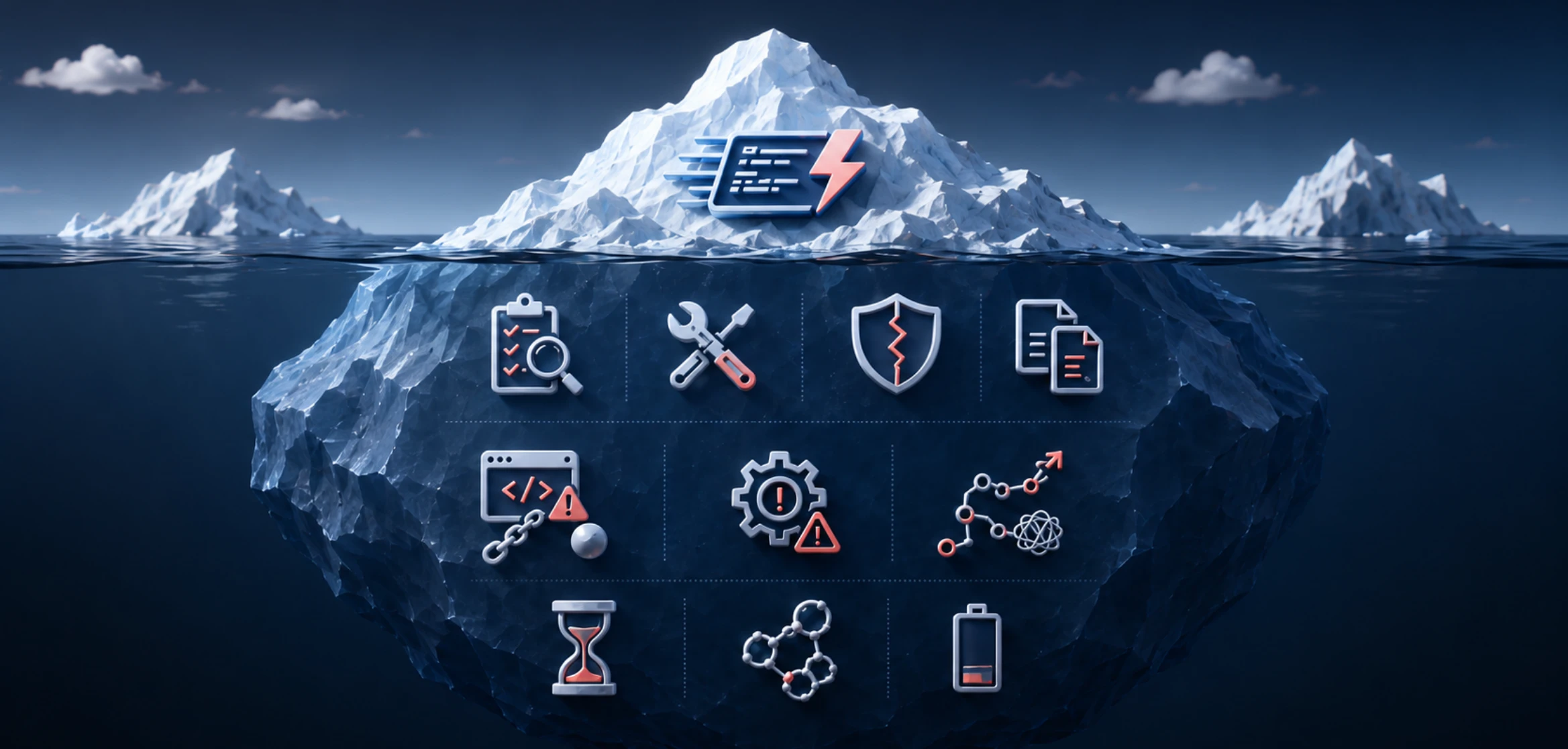
But if that code is not understood, reviewed, tested and integrated correctly, the time gained initially can reappear later in another form:
- more time spent in review
- more fixes
- more vulnerabilities to address
- more duplication
- more technical debt
- more difficulty maintaining or evolving the application
- shorter application lifespan
In other words: what seems cheaper at the start can become more costly later.
Not because AI is bad in itself.
But because durable software does not rely solely on production speed. It also depends on the quality of the design, architectural coherence, security, testing, documentation and understanding of the business.
What the numbers say
Several recent studies point in this direction.
GitClear analysed 211 million lines of code between 2020 and 2024. The study notably observes a decrease in refactoring, more code duplication and an increase in code being rewritten shortly after it was added.
CodeRabbit, for its part, compared pull requests co-written with AI to entirely human pull requests. Result: AI-assisted code contained more security vulnerabilities, and review time increased significantly.
Finally, the METR study conducted in 2025 with experienced developers showed a counter-intuitive result: developers thought they would save time with AI, but on existing and complex codebases they were actually slowed down. The reason: the cost of verifying, correcting and understanding generated code can exceed the initial time saving.
These figures do not say that AI is useless.
They say something else, more interesting:
AI mainly accelerates what is already well framed.
If the project is clear, the architecture solid, the business rules understood and tests well designed, AI can become a real accelerator.
But if the framework is fuzzy, it can also accelerate the wrong decisions.
Quick prototype ≠ Business tool
Let’s take a simple example:
An educational planning application.
Creating a first version of an application in a few days to test an idea can be very relevant.
But building an educational planning application used every day by teachers, with personal data, complex business rules and security requirements, is not the same level of commitment.
In this type of project, you need to think about:
- the architecture over several years, not just a few weeks
- security from the start, not afterwards
- access rights and sensitive data
- business edge cases, not just the ideal scenario
- documentation for the teams who will maintain the tool
- documentation for users
- the future evolution of the platform
These elements do not come automatically from a prompt.
They require real technical, professional and above all human understanding.
Our approach at Dexio
At Dexio, we are not opposed to vibecoding.
On the contrary: we use AI because it helps us work better.
But we do not use it as an autopilot.
We use it as an assistant.
Concretely, this means that:
- the architecture is designed by a human
- generated code is read, understood, validated or modified
- technical choices remain controlled by the team
- tests cover real business cases, not just simple cases
- integrations with existing tools are properly designed
- security and data are taken into account from the start
- future maintenance is part of the project
AI can produce quickly. Our role is to ensure that what is produced is reliable, useful and maintainable.
In summary
Vibecoding can save a lot of time at the start.
But for a company, the issue is not just producing code: it is building a reliable, secure and maintainable tool.
Whether code is generated by AI or written manually, it must be entrusted to people capable of understanding it, testing it, maintaining it and taking responsibility for the technical choices.
That is where the real difference is made.
At Dexio, we use AI to accelerate development, but never to replace expertise. Every technical choice, every integration and every feature remain overseen by developers capable of designing, verifying and maintaining what is delivered.
Because in the end, it is not the prompt that guarantees the quality of a business tool.
It is the people who build it.