What is an MCP server?
Artificial intelligence is advancing rapidly. Very rapidly.
But behind the spectacular demonstrations and appealing conversational interfaces, a more fundamental question arises:
How can AI be seamlessly integrated into an existing business system?
This is precisely where the MCP server comes in.
In this article, we explain in simple terms what an MCP server is, what it is actually used for, and why it is becoming strategic for businesses wishing to integrate AI in a controlled manner.
The direct answer!
An MCP (Model Context Protocol) server is an orchestration layer that allows an artificial intelligence to access, in a secure and structured way, the data and functionalities of a business system.
In simple terms:
-
It acts as a bridge between an AI model and your internal applications.
-
It precisely defines what the AI can see, understand and do.
-
It ensures that the integration remains under control.
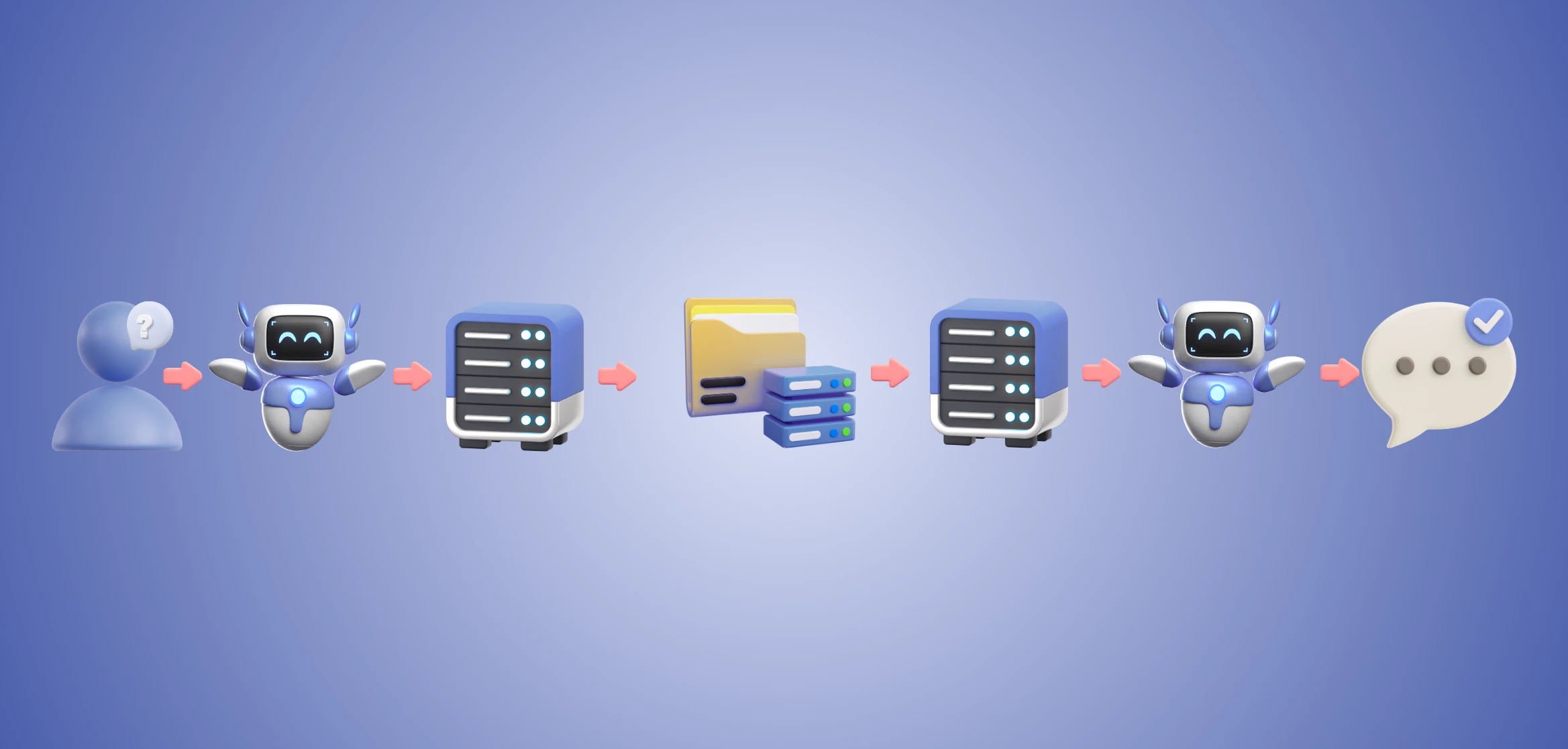
It can be explained simply as follows: the AI identifies the tool it needs, the MCP server queries the relevant systems (ERP, CRM, internal APIs, databases) and returns a structured, actionable response.
Without this layer, the AI remains generic.
With it, it becomes truly useful.
Why MCP servers are becoming essential
An AI model, however capable, does not know your HR rules, your internal processes, your contracts, your customer data, your pricing logic, your regulatory constraints.
Without structured access to business context, the AI remains abstract.
The MCP server allows that context to be injected. And that is precisely where value is created.
How does an MCP server actually work?
Let's take a simple example.
-
The user asks a question
"What is my remaining holiday balance?"
-
The MCP server establishes the connection
It will:
-
verify identity and access rights,
-
query the HR system,
-
apply internal rules,
-
structure the data.
-
The AI reformulates
It provides a clear, contextualised response:
"You have 8 days of holiday remaining."
The AI does not "guess" anything. It uses real data, via a controlled architecture.
BenefitMe is a co-creation that serves as a concrete example. We invite you to take a look; this way, you will gain an overall view of what an MCP server can enable.
Concrete business use cases
HR assistant connected to internal systems
An employee interacts with a conversational assistant.
The MCP server:
-
applies access rules,
-
queries the HR software,
-
contextualises the responses.
Result: a fast, personalised service without directly exposing the database.
Enhanced customer support
An assistant can:
-
consult a customer's history,
-
check the status of an order,
-
trigger an action in a CRM.
The MCP server supervises each interaction and logs the actions performed.
Management and reporting
An executive asks:
"Give me the monthly sales by region."
The MCP server:
-
queries the database,
-
applies the necessary filters,
-
passes structured data to the model.
The AI then transforms this data into a readable summary.
Why this is not just a technical issue
Many companies integrate AI via standard tools.
That works for simple uses. But as soon as AI becomes structuring, a solid architecture is essential.
An MCP server enables:
-
Deep integration into existing workflows
-
Fine-grained permission management
-
Action traceability
-
A scalable architecture
-
Better data control
In other words: you don't add an AI "on top of" a system. You integrate it properly.
Common mistakes to avoid
Connecting AI directly to a database
It is risky, hard to audit and rarely secure. The MCP server creates a controlled abstraction layer.
Reducing AI to a simple chatbot
A chatbot is only an interface. The real value lies in business integration and data orchestration.
Neglecting governance
Who can access what?
Which data leaves the system?
Which actions are authorised?
A well-designed MCP server answers these questions from the scoping phase onwards.
MCP server and data sovereignty
For a Swiss or European company, data control is central.
An MCP server allows you to:
-
host the client-side logic,
-
precisely control data flows,
-
log interactions,
-
integrate locally hosted models if necessary.
It becomes a strategic lever, not just a technical one.
In summary
An MCP server is the link that allows AI to connect to a business system, to structure context, to secure access and to turn a generic AI into an operational assistant.
AI alone impresses. A controlled architecture makes it truly useful.
And now?
If you are considering integrating an AI assistant into your company, the question is not only:
Which model to choose?
But above all:
How to integrate it properly into your existing architecture?
This is often where the success of a project is decided.
At Dexio, we support our clients to scope, design and integrate robust AI architectures, tailored to their business context and constraints.