Technology in the service of intercultural communication: can a tool speak to all its users?
One application, users from all corners of the world, and a wealth of languages and cultures. How do you design a tool that respects these differences while remaining easy to understand and use every day?
As an international city, Geneva presents a particular challenge when it comes to developing bespoke solutions.
Adapting a solution that speaks to everyone and can be used easily, whatever their background or culture, is no easy task.
Especially since a solution is only useful when it brings users together and makes their daily lives easier, rather than the other way round. Because speaking to all your users also means taking account of their language, culture, needs and ways of working.
Technology brings us closer…
Historically, technology has always helped bring people closer together. The telegraph and then the telephone made it possible to communicate across continents, the internet made these exchanges part of everyday life, and standards such as Unicode now make it possible to display every writing system in the world on the same screen.
More recently, new tools have reduced distances even further:
- real-time translation and subtitles;
- video conferencing, which makes it possible to collaborate remotely across several countries and time zones;
- automatic translation of messages, as on Airbnb, where a host and a traveller can each communicate in their own language;
- generative AI, which helps rephrase and adapt content for its audience.
…but connecting does not mean understanding
A translated message is not necessarily an understood message. Words convey only part of the meaning, and translation has its limits:
- unspoken meaning and implications are easily lost;
- humour often relies on references and wordplay specific to a culture and language;
- levels of politeness vary considerably from one country to another;
- non-verbal cues (gestures, silences, intonation) are largely lost in writing;
- in some cultures, meaning is conveyed more through context than through the words themselves.
Communicating with someone whose culture and history differ from ours therefore requires knowledge of many conventions that a simple translation tool cannot convey.
And these subtleties are not limited to conversations: the tone of an error message or the meaning of an icon can also vary from one culture to another.
When these limitations become too restrictive and a user does not feel represented by a tool, they do not always complain. Often, they simply abandon it and turn to solutions that speak to them more: an Excel spreadsheet, personal messaging, or a conversation. For the organisation, these all come with hidden costs: wasted time, scattered information and a tool that fails to do its job.
Speaking to everyone is a matter of design
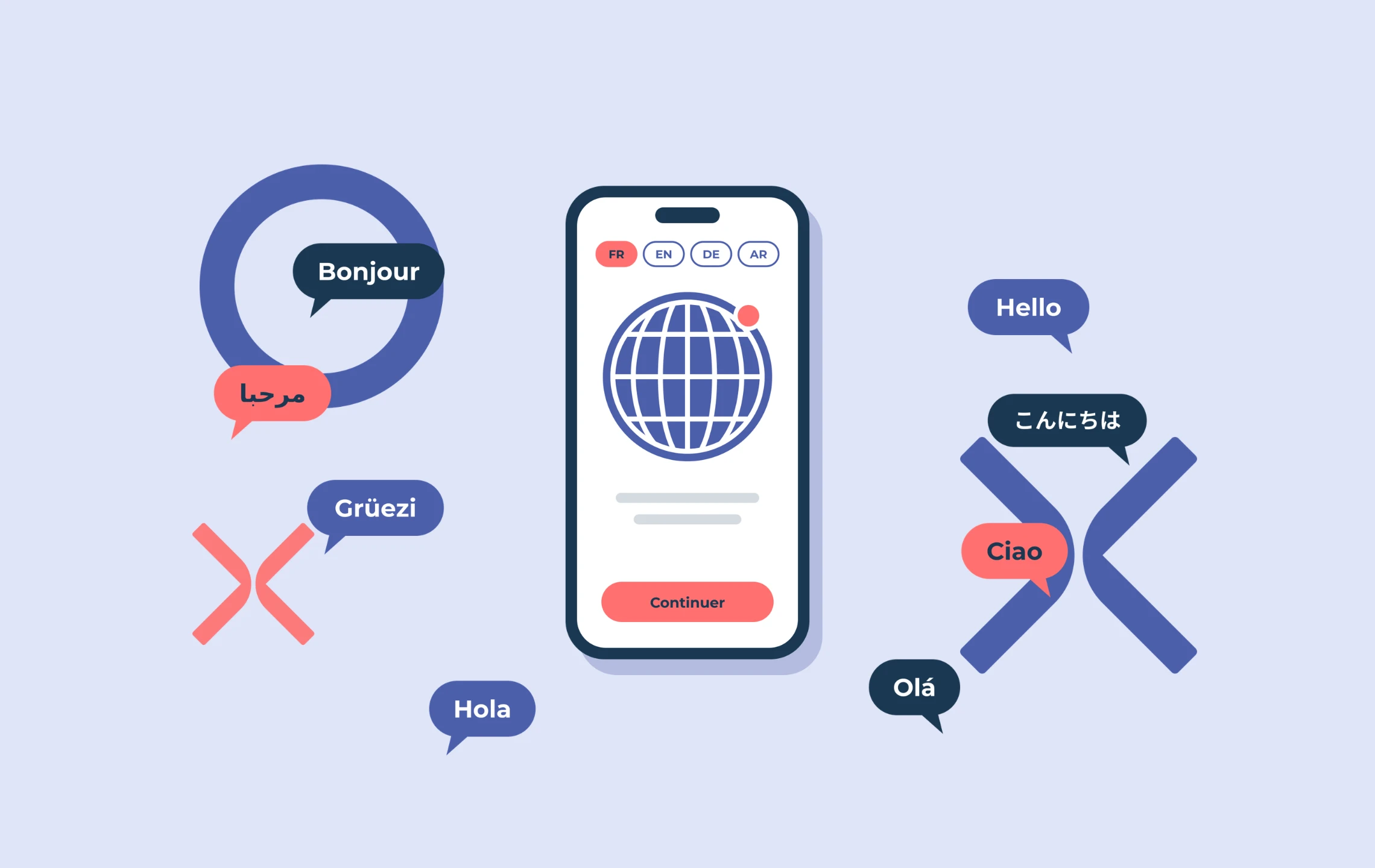
Speak their language: localise rather than translate
Translation means replacing words with others. Localisation means genuinely adapting a tool to the people who use it. The content of pages (texts, articles, documents) is usually written and translated by the organisation itself. The interface, however, is shaped from the design stage: buttons, form labels, menus, confirmation or error messages. It guides users at every step, and it needs to speak their language. And the differences go far beyond words.
In Switzerland, 3 November 2026 is written as 03.11.2026, but in the United States as 11/03/2026, where the month comes before the day. In Switzerland, the format is 1'250.50 CHF; in France, it is 1 250,50 €. In some countries, the surname comes before the first name. Arabic and Hebrew are read from right to left, reversing the entire logic of an interface. Even colours and icons are not universal: a symbol that is perfectly clear to us may be misunderstood, or even viewed negatively, elsewhere.
These adjustments cannot be improvised at the end of a project. They need to be planned from the outset, in the very architecture of the tool. This is known as internationalisation: preparing software to accommodate multiple languages and formats without having to rebuild everything. Adding this capability later generally costs more than planning for it in advance.
That is why at Dexio, even when a project is not necessarily intended for use in several languages, we always plan for internationalisation during development, so we can anticipate potential changes or future updates.
Speak their culture: respect working habits
Beyond language, every team has its own way of working, often shaped by its culture. In some organisations, a decision goes through several levels of approval. In others, everyone is free to act directly. Some cultures favour written communication and a formal record, while others favour verbal exchanges and relationships.
A tool that imposes a single way of working may therefore suit only some of its users. The right approach is to start with actual practices, rather than asking teams to change how they work to fit the software.
AI: an interpreter that needs guidance
Among the technologies that bring users closer together, AI holds a place of its own. Where conventional translation replaces words one by one, AI can take account of context, tone and the way people actually express themselves.
Above all, it changes the way people interact with a tool. Users no longer need to know the software’s vocabulary or search through menus: they can ask questions in their own words. This is the principle behind the intelligent assistant Dexio developed for BenefitMe, an HR platform. Employees ask it questions as they would a colleague, and the assistant searches the internal documentation for the answer before rephrasing it clearly.
But AI does not remove the limitations mentioned above. It can even amplify them. Models are mostly trained on English-language and Western content: they reproduce its frames of reference and biases, and remain less reliable in less widely represented languages. A fluent answer is not necessarily a correct one, and a well-worded mistake is harder to spot. If not properly guided, AI therefore risks serving users who already resemble it better, to the detriment of others.
When used well, AI can help a tool speak to everyone, provided it is properly guided. For BenefitMe, Dexio made strict choices from the outset: hosting in Switzerland, data anonymised in advance, and a model used in a controlled environment. The assistant handles simple, repetitive questions, but does not replace HR teams or their decisions.
The Dexio approach: decode before you code
Decode
Before setting out to code the ideal solution, you first need to understand the people who will use it. By talking to teams and meeting users, we gain a concrete understanding of their needs, habits and differences. At Dexio, our own team brings together a variety of backgrounds and career paths: we know how important it is to include everyone, both in our thinking and in our processes.
Code
Once we know who the tool is for, it becomes much easier to decide what to develop. Languages, formats and the integration of AI are all considered from the outset, rather than added later. This minimises back-and-forth once the tool has been delivered and enables our clients to have a solution that is fit for purpose from the moment it goes live.
How can you tell if your tool is intercultural?
A few questions are all it takes to take stock:
- Is your tool available in the language of each of your users?
- Are dates, amounts and addresses displayed in the right format for everyone?
- Can your users understand the tool without training or internal jargon?
- Does it respect the way your teams work?
- Do your employees actually use it, without turning to other apps or tools on the side?
- If you use AI, do you know where your data is stored?
If you answered “no” to one or more of these questions, your tool could benefit from being more inclusive and speaking to a wider range of its users.
Decode differences to code tools that bring people together
A tool does not automatically speak to all its users, but it can learn to do so if it is designed with them and, above all, for them. When language, culture and ways of working are considered from the outset, friction decreases and users are less likely to become discouraged. Designing for a broad audience means enabling everyone to see themselves in the solution, and preventing teams from becoming fragmented across several parallel tools.
Would you like to make your tools more inclusive and better suited to all your teams? Dexio supports you from understanding your users through to developing a solution that really speaks to them.